
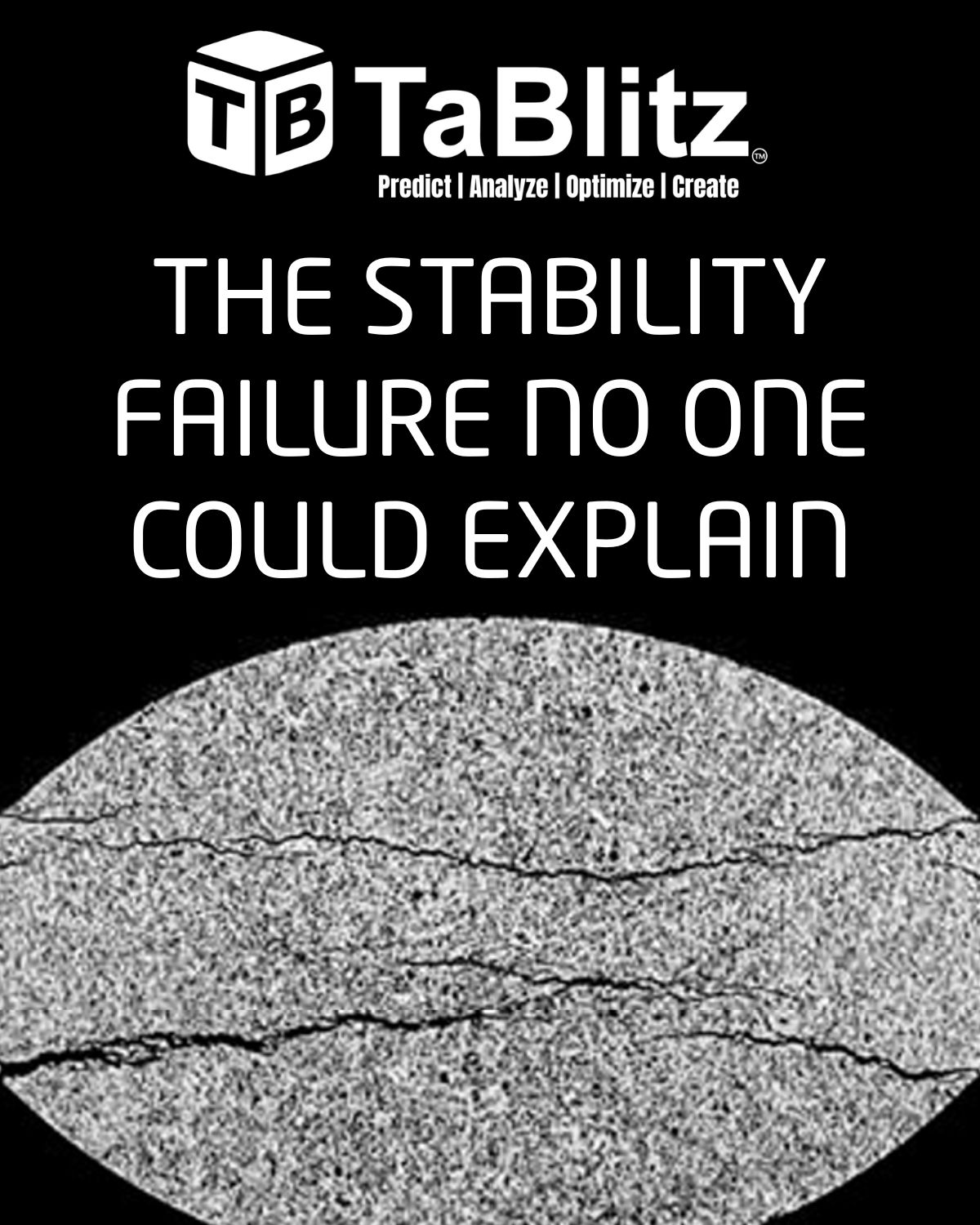
When Stability Fails Without Warning
A formulation team recently faced a costly and frustrating problem: their tablets were failing stability within days. The tablets began swelling, thickness increased, and coating integrity was compromised under accelerated conditions.
Because the formulation contained hygroscopic components and a high API load, the initial assumption was moisture uptake. The team began troubleshooting—adjusting excipient levels, modifying compression forces, testing coating conditions, and evaluating process parameters. Yet after weeks of work and multiple batches, the root cause remained unclear.
Looking Beyond the Formulation
Instead of running another round of experiments, the team partnered with TaBlitz and Natoli Scientific to investigate the problem from a different perspective—by analyzing the physics and internal structure of the tablet itself. Using TaBlitz’s material characterization tools, the deformation behavior of the formulation was evaluated to understand how the material responded during compression. This allowed the team to narrow the list of possible causes and focus the investigation where it mattered most.
The Root Cause Hidden Inside the Tablet
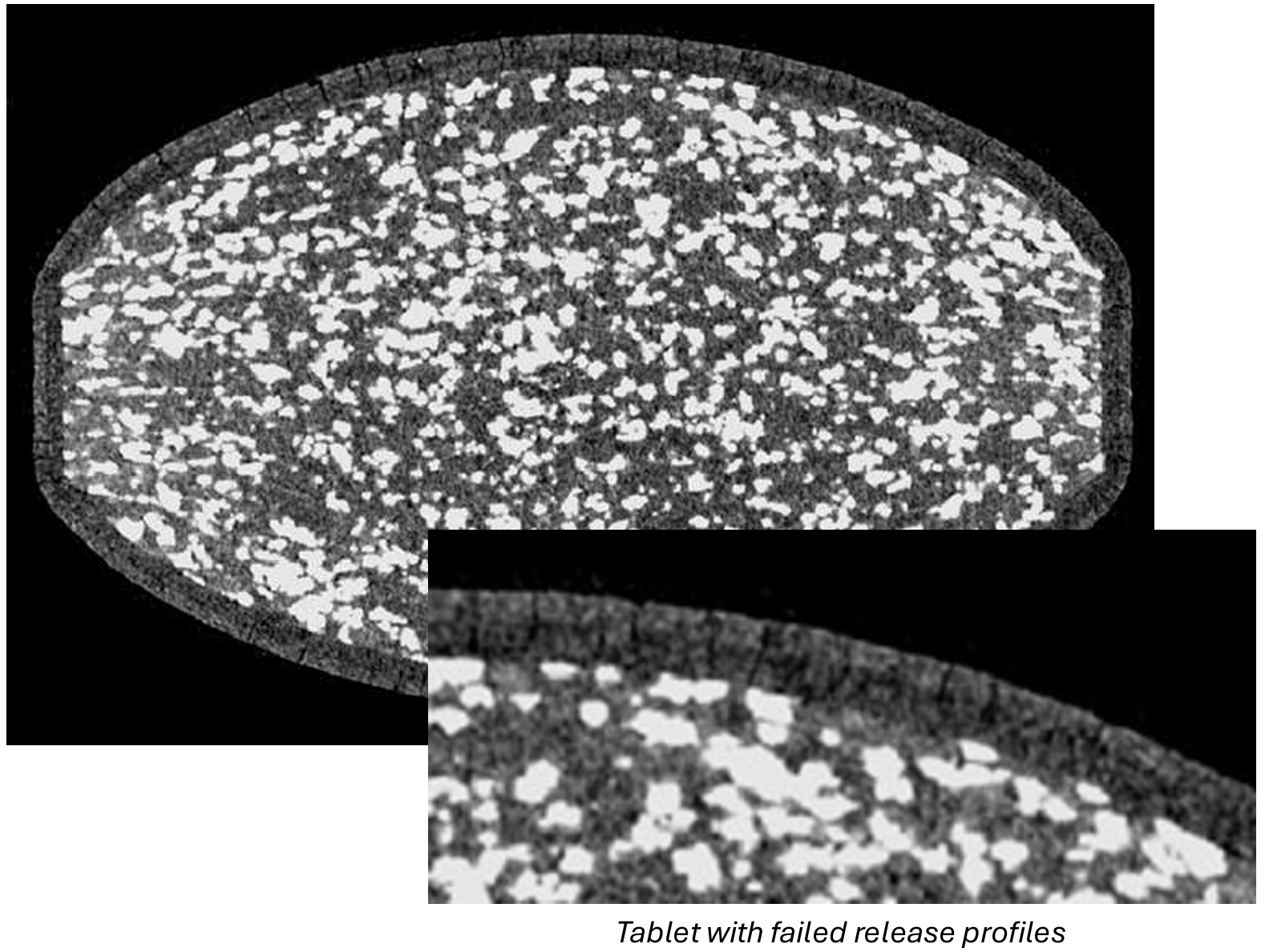
Next, high-resolution CT scanning was used to examine the tablets internally without destroying them. The scans revealed something that traditional quality control methods could not detect: non-uniform coating thickness and microscopic cracks in the coating layer. These defects allowed moisture to penetrate the tablet core during stability testing, leading to swelling and coating failure. What initially appeared to be a hygroscopic formulation problem was actually a coating integrity issue.

From Guesswork to Insight
Once the root cause was identified, the solution became clear—optimize coating uniformity and eliminate the microcracking mechanism. The stability issue was resolved, saving significant time, material, and development effort. When the true cause of failure is hidden within the tablet structure, teams can spend weeks adjusting the wrong variables. TaBlitz helps development teams see what traditional methods cannot—turning uncertainty into actionable insight.
TaBlitz helps teams:
Diagnose tablet defects faster
Understand compaction and deformation behavior
Visualize internal tablet structure with CT analysis
Reduce trial-and-error development work
Accelerate formulation troubleshooting


Your Tablet Already Knows the Problem. We Help You See It.
Contact us to learn how CT scanning and root cause analysis can support your formulation and stability programs.